[Editor’s note] Lingang New Area is a young city full of vitality, dreams and hopes. Lingang New Area is a city of young people, a city of young people’s innovation and entrepreneurship, a city of employment and happiness, and a city of livable and peaceful living. In the past four years, the cumulative number of talents introduced into Hong Kong New Film has increased by 128.5% annually. The Morning News has launched a series of people’s reports on "Lingang New Youth", aiming to observe Lingang New Area as a "young city, a city of young people" from their perspective by telling stories about young people going to Lingang, taking root in Lingang and dreaming of Lingang.
It is an established accident in his life that the trajectory of life meets in Shanghai; It is inevitable for him to constantly exert his own ability and light and heat for the development of biomedical industry for many years. The project landing, focusing on the most cutting-edge technology and developing innovative vaccines are the decisions he has always insisted on. He is Dr. Liu Jian, general manager of Kangxinuo Bio (Shanghai) Co., Ltd. (hereinafter referred to as "Kangxinuo (Shanghai)").
It was not until he stood in front of the bright glass curtain walls of three brand-new factories delivered in advance by Life Blue Bay Park that Liu Jian finally felt the legendary "port-facing speed" for the first time.
This is the end of November 2021. Less than two months ago, they just signed a contract with 23 other key biomedical industry projects to settle in the Life Blue Bay Park in Lingang New Area. Until today, Liu Jian often introduced to people: "Our three buildings were the first to be capped and delivered in the tenth phase of Life Blue Bay Lingang Zhizao Garden." At that time, the rest of the factories were under construction.
Under the epidemic situation, the market demand for innovative vaccines is particularly strong, and the demand for factories by Kangxinuo Bio is also very urgent. After visiting many places, Kangxinuo (Shanghai) was incorporated in Lingang New Area on August 18th, 2021. The company bears the heavy responsibility of building the technology platform of Kangxinuo bio-mRNA and realizing the commercialization of products.
Therefore, they invested 1 billion yuan in one fell swoop to carry out the construction of mRNA vaccine research and development and industrialization projects with a building area of 17,800 square meters, including a commercial production line with an annual capacity of 100 million doses and a pilot-scale production line. It can be predicted that this platform will provide a good solution for the prevention and treatment of major infectious diseases in the future.
Recently, Liu Jian said in a thoughtful interview with the Morning News that Kangxinuo (Shanghai), a young company, has experienced the process of growing up with this young city in the two years since it settled in Lingang. They not only focus on contributing to the port, but also hope that their products can contribute to the country and Shanghai.
Liu Jian, born in 1981, graduated from Peking Union Medical College (Tsinghua University Medical Science Department) with a major in pharmaceutical analysis, and is now studying in the EMBA of China Europe International Business School. After graduating from Ph.D., he successively worked in the general office of Tianjin Municipal Government, the general office of Anhui Provincial Government and the administrative committee of Tianjin Economic and Technological Development Zone. In 2021, he joined Kangxinuo Bio as the vice president of the group and the general manager of Kangxinuo (Shanghai), and was responsible for the daily operation and management of the Shanghai company. He led and promoted the construction of Kangxinuo (Shanghai) mRNA technology research and development center and industrialization base, and was awarded as "the leading talent of industrial elite in 2022" in Shanghai.
According to Liu Jian, Kangxinuo mRNA technology platform has been inspected too much in site selection, and finally chose to settle in Lingang because it values the gathering of biomedical industry in Lingang, efficient government services and complete talent guarantee policies, and empowers enterprises through industrial chain, innovation chain and talent chain.
He compared the whole region to a tropical rain forest. Every enterprise is like a myriad of plants in the rain forest, some are towering trees, some are bright flowers, and some are lush grass. But the growth of all plants is inseparable from the key elements of sunshine, soil, air and water, which are the regional industrial innovation ecology, business environment and talent guarantee.
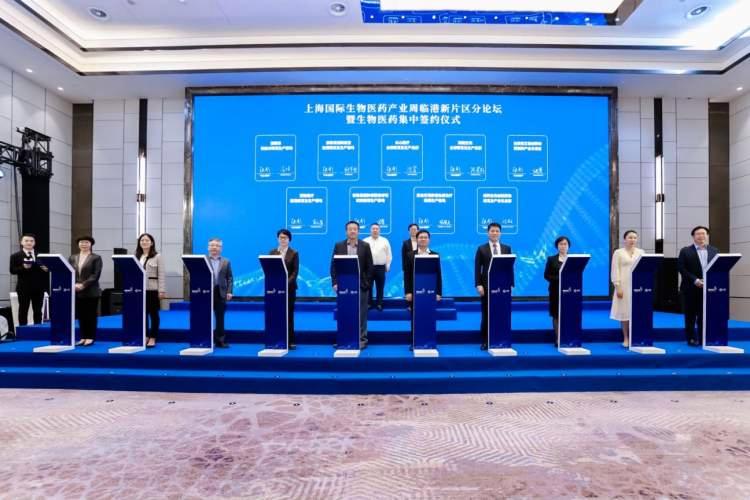
Centralized signing ceremony of biomedicine
Liu Jian said that in the delivery process of Kangxinuo (Shanghai) Biotechnology Factory, in order to promote the delivery of the factory as soon as possible, all parties in the park set up a special team to provide full service for the project and fully coordinate to ensure the early completion and delivery of the factory. For all requests and questions of Kangxinuo (Shanghai), the team staff basically did not reply overnight, no matter how late, they would respond on the same day.
With the support of the spirit of "It’s not too late" of the Management Committee and the Park, finally, less than two months after the formal signing, at the end of November 2021, three customized workshops in Kangxinuo (Shanghai) were officially delivered, becoming the earliest capped and delivered workshop in Life Blue Bay. And this is a demonstration of the "full-cycle butler service" mentioned by Qu Xia, the chief planner of Life Blue Bay, when interviewed by us.
Kangxinuo (Shanghai) is also unambiguous, and their promised investment of 1 billion yuan has also been fulfilled since then.
Kangxinuo (Shanghai) mRNA vaccine industrialization base uses more domestic equipment, and the domestic rate of equipment and raw materials reaches 80%. Most of them are in Shanghai and the Yangtze River Delta region, and many partners are in Lingang. At the same time, as downstream enterprises in the biomedical industry chain, they also provide markets and platforms for more upstream enterprises in the industry chain. Through continuous optimization and verification, they can jointly improve the development level of the whole industry chain.
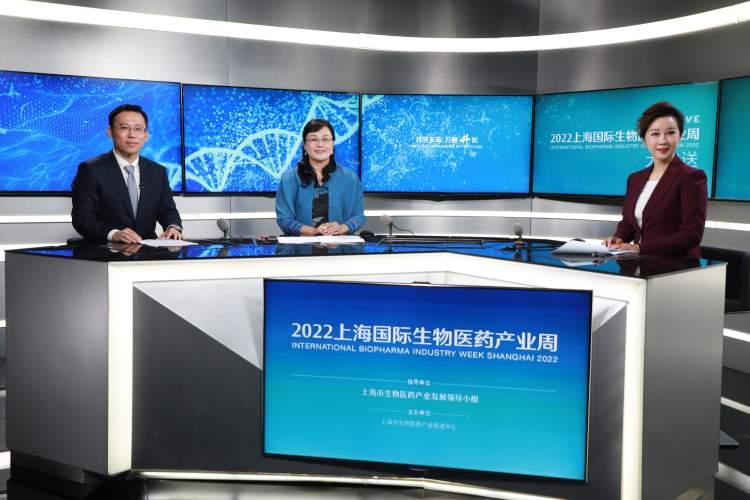
Liu Jian in the interview
"What I want to talk about most is talents, cities and cities, and the core competitiveness of regions and regions is talents. Talents are not only the source of power for urban industrial development, but also the source of vitality for urban innovation and development, and it is also the source of potential for endogenous development of a city. Let talents come, stay and live well. The development of talents in enterprises is also the core. In enterprises, I have always stressed that we should be people-oriented, respect talents and cultivate talents. The key for the government to support the development of enterprises is to help enterprises attract and retain talents. In just one year, with the help of the talent policy advantage of Lingang New Area, we absorbed industry talents throughout the country and quickly established the Shanghai team. " Liu Jian told reporters.
Lingang has formulated many targeted policies in terms of talent settlement, house purchase and individual tax support. As a key supporting enterprise in Lingang, postgraduate students can settle down in one year, and some undergraduate students in R&D or important management positions can also settle down in two years, which is very attractive to many people from other places who come to Shanghai to develop. In addition to settling down, Lingang also provides a multi-level housing security policy, and various affordable housing such as public rental housing provides more choices for employees of Lingang enterprises.
Liu Jian said that to live in peace and contentment, he sometimes encourages employees to buy a house in Lingang in small talk. First, the price of the house is acceptable to most young employees from other places who are new to Shanghai. Second, we are optimistic about the economic and urban development of Lingang in the future. Leading industries such as new energy, new materials, equipment manufacturing, integrated circuits and artificial intelligence are all strategic emerging industries, which have great potential for future development. With industrial development and enterprise gathering, there will be a constant influx of new talents, and the development of industrial economy and the increase in personnel demand will inevitably drive the urban development forward.
Not long ago, the branch school of the Second Affiliated Middle School of China Normal University was officially launched … The continuous improvement of these living facilities will attract more talents. Talent gathering injects power into enterprise development, enterprise development adds vitality to regional economic prosperity, and regional economic prosperity provides attraction for enterprises to retain talents. Such a virtuous circle will surely realize the win-win development of regions, industries, enterprises and talents.
Liu Jian recalled that in 2017, Kangxinuo Bio had already paid attention to mRNA technology. At that time, European and American biotechnology companies had made progress in the field of mRNA, although it was not used to develop preventive vaccines at first. After the outbreak of COVID-19 in 2020, in June 2021, Pfizer /BioNTech and Moderna introduced their respective vaccines developed and produced on the mRNA platform to the market, and at this time, the technology research and development of Kangxinuo Bio in mRNA has also made great progress.
At the beginning of landing, Kangxinuo (Shanghai) devoted itself to a battle against time against time. Liu Jian led his team to overcome the difficulties caused by the epidemic and did everything possible to ensure the smooth development of products. In April, 2022, novel coronavirus mRNA vaccine, the first heavyweight product launched by Kangxinuo (Shanghai), won the approval of National Medical Products Administration drug clinical trial, which was also the first batch (only two) of mRNA vaccines in China and the first in Shanghai to obtain clinical approval for COVID-19 mutant, truly realizing the whole chain from research and development to production in Shanghai.
Liu Jian could not help feeling when he recalled to us. "In April and May last year, we actively communicated with the governments of Lingang and Zhangjiang, and won the early resumption of work. We have some R&D personnel entering the laboratory in advance and continue to carry out some R&D work. The Lingang side also allows project construction personnel to enter the project construction site in advance. "
Return to work ahead of schedule
As the whole mRNA vaccine industrialization project was fully resumed, it actually started in June 2022. During this period, it also experienced adverse effects such as shortage of workers, insufficient building materials, logistics stagnation, equipment delay, and high-temperature construction. However, the Shanghai team still managed to seize the construction period for several months and finally completed the whole project construction in December 2022.
Since April 2022, this vaccine has entered the clinical trial stage. "We have carried out phase I, phase II and IIT clinical trials, with a total of about 1,400 people, and obtained very good clinical trial data. This vaccine has good safety, quick onset and broad spectrum, and can produce high neutralizing antibodies against a variety of COVID-19 variant viruses. These data are published in the medical journal Nature.
On August 7, 2023, Kangxinuo Bio and AstraZeneca signed the Framework Agreement on Product Supply Cooperation, which will provide contract development and production services to AstraZeneca to support its mRNA vaccine project. As the strategy of the whole group, the product pipeline of the future mRNA technology platform will be laid out in Shanghai. It can be predicted that this platform will provide a good solution for the country to prevent and control major epidemic infectious diseases in the future.
Kangxinuo (Shanghai) was founded only two years ago and is still a young company. In the future, Liu Jian hopes that the company can grow together with Lingang New Area and achieve mutual success.
"I used to work in the economic development zone, so I have great feelings for the industry and the development zone. I think the future development of Lingang is very promising." He said, "In the process of development, Lingang has a very good industrial positioning. It focuses on strategic emerging industries, except biomedicine, as well as new energy, new materials, equipment manufacturing and integrated circuits. In addition, it is supported by Yangshan Port, and the advantages of free trade zone and port are very obvious. Moreover, multiple talent advantages, industrial advantages and policy advantages, as well as the advantages of living security, add up together, so I am very optimistic about the future development of Lingang. "
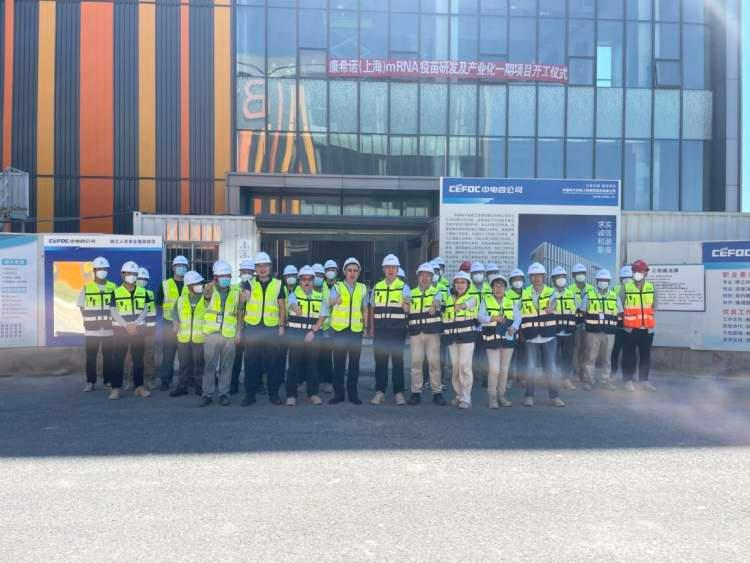
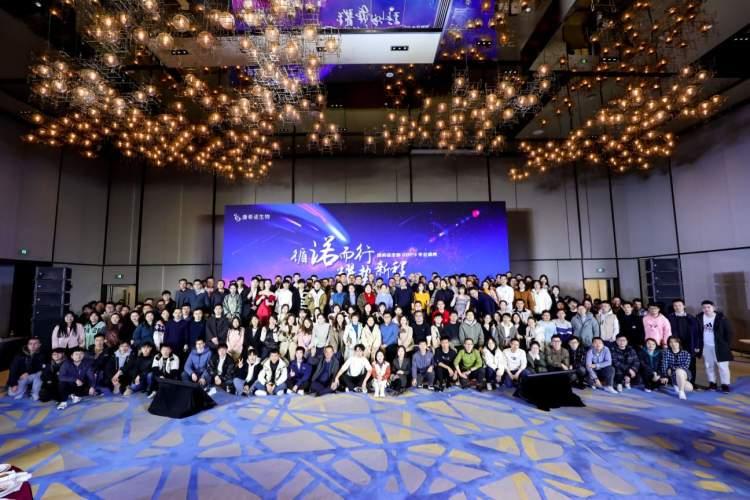
Group photo of Kangxinuo (Shanghai) annual meeting
Lingang is a new city, and mRNA is a brand-new technology platform. "I have said on many occasions that we are a new technology platform and we should give this platform time. New technologies often need a incubation period, and when it really exerts its strength, it may be a blowout. "
After coming to Hong Kong, he not only established Liu Jian’s mRNA technology and process development and innovation studio, but also undertook the Shanghai emergency research project "novel coronavirus mRNA vaccine phase I clinical trial" and the Lingang New Area strategic emerging industry development project "Kangxinuo (Shanghai) mRNA vaccine research and development and industrialization phase I project", and was awarded the title of Shanghai industrial elite leader in 2022, Lingang Group’s outstanding Communist party member in 2021-2023, and so on.
What makes him feel lucky is that what Kangxinuo (Shanghai) is doing in Shanghai Lingang has received strong support from the park to the government. "On the surface, these honors have been given to me. But what is reflected behind the honor is everyone’s affirmation and expectation for a technical platform like mRNA. " Liu Jian believes that guided by science and technology, focusing on new technologies and platforms, Kangxinuo (Shanghai) Company will surely form a joint force with the development of biomedicine in Lingang New Area, and make our contribution to the development of biomedical industry in China and Shanghai.